Our School Garden
Read the text and answer the questions 1, 2 and 3
Our school has a lovely garden in front of the big playground. A fence encloses the garden. In the garden, there are many beautiful flowers like roses, sunflowers, jasmines and marigolds. A swarm of butterflies dances on the flowers. It makes the garden look very beautiful.
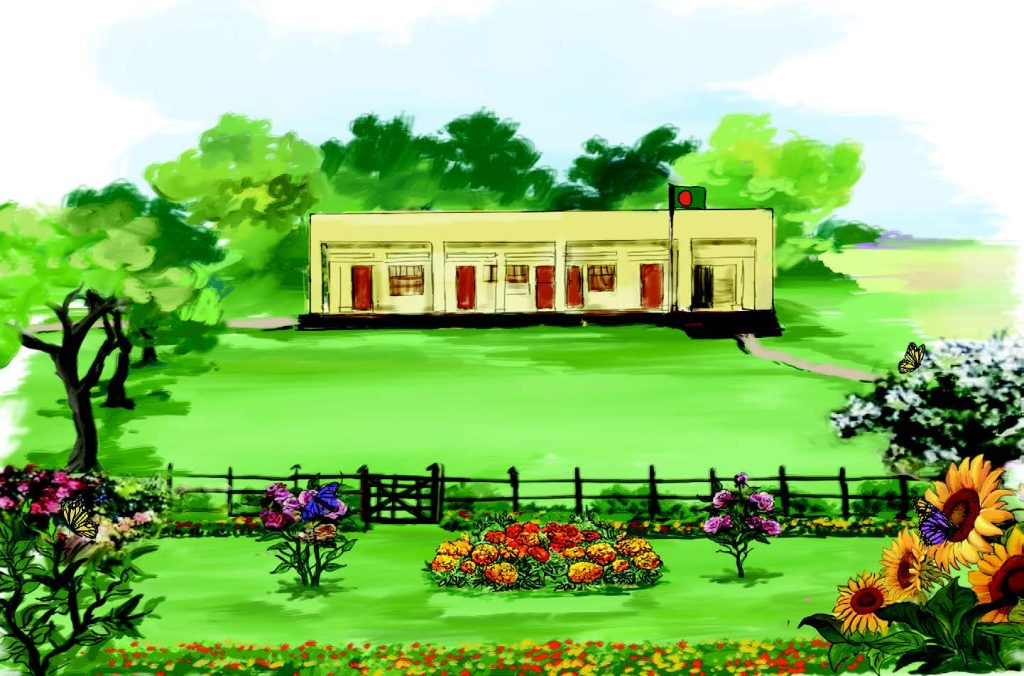
There is a ditch near the corner of the garden. A group of frogs live there. Sometimes, we see a flock of birds sitting on the nearby trees, singing sweet songs.
We take care of the garden regularly. On a selected day, students from each class work together to clean the garden. We use a set of gardening tools like spades, rakes, and sickles. We water the plants and remove the weeds regularly. We also add compost to the soil for making it fertile.
The garden is full of plants and flowers. They give us joy and happiness. We love working in our school garden.
1.1 Read the following statements. Write ‘True’ in your answer script if the statement is true. Write ‘False’ in your answer script if the statement is false.
- The school garden is located behind the playground.
- A fence surrounds the garden.
- The garden has roses, jasmines, sunflowers, and marigolds.
- A swarm of bees dances on the flowers in the garden.
- The butterflies make the garden look beautiful.
- There is a pond near the corner of the garden.
- A group of frogs lives in the ditch.
- Sometimes a flock of birds sits on nearby trees.
- The birds sing sweet songs.
- Students rarely take care of the garden.
- Students from each class help clean the garden.
- The gardening tools mentioned are spades, rakes, and hammers.
- Students water the plants regularly.
- Students add compost to the soil to make it hard.
- The garden is full of plants and flowers.
- The flowers give students joy and happiness.
- The students do not like working in the garden.
- The garden has only one type of flower.
- The passage says the birds build nests in the garden.
- The students remove weeds from the garden regularly.
1.2 Write the answer on the answer paper
1. Where is the school garden located?
(a) Behind the school (b) In front of the big playground
(c) Next to the cafeteria (d) Behind the classrooms Answer: (b)
2. What encloses the garden?
(a) A wall (b) A hedge (c A fence (d) A row of trees
3. Which of the following flowers is not mentioned in the passage?
(a) Roses (b) Sunflowers (c Jasmines (d) Tulips
4. What dances on the flowers in the garden?
(a) A swarm of bees (b) A swarm of butterflies (c) A group of birds (d) A group of frogs
5. How does the butterfly swarm make the garden look?
(a) Colorless (b) Noisy (c) Very beautiful (d) Dirty
6. What is found near the corner of the garden?
(a) A playground (b) A ditch (c) A classroom (d) A pond
7. What lives in the ditch?
(a) A group of fishes (b) A group of snakes (c) A group of frogs (d) A group of ducks
8. What do the students sometimes see sitting on nearby trees?
(a) A flock of parrots (b) A flock of birds (c) A swarm of bees (d) A herd of goats
9. What do the birds do on the trees?
(a) Sleep (b) Sing sweet songs (c) Build nests (d) Fight
10. How often do students take care of the garden?
(a) Once a year (b) Rarely (c) Regularly (d) Never
11. Students from each ______ work together to clean the garden.
(a) Country (b) Class (c) House (d) Group
12. Which of the following is a gardening tool mentioned?
(a) Hammer (b) Screwdriver (c) Spade (d) Paintbrush
13. What tool is not mentioned?
(a) Rake (b) Spade (c) Sickle (d) Shovel
14. What do the students do to the plants?
(a) Ignore them (b) Sell them (c) Water them (d) Burn them
15. What do students remove regularly from the garden?
(a) Water (b) Weeds (c) Soil (d) Rocks
16. Why do students add compost to the soil?
(a) To make it dry (b) To make it hard (c) To make it fertile (d) To make it colorful
17. The garden is full of ______.
(a) Animals (b) Cars and toys (c) Plants and flowers (d) Stones
18. What do the plants and flowers give the students?
(a) Food (b) Joy and happiness (c) Money (d) Homework
19. How do students feel about working in their school garden?
(a) They dislike it (b) They don’t care (c) They love it (d) They avoid it
20. What type of collection is a “flock” associated with?
(a) Frogs (b) Birds (c) Flowers (d) Insects
21. What is the meaning of “swarm” in the passage?
(a) A single butterfly (b) A large group of insects (c) A garden tool (d) A type of flower
22. What is the first thing mentioned in the passage?
(a) Birds (b) The garden (c) The playground (d) Trees
23. Why is the garden beautiful?
(a) Because of the fence (b) Because of the flowers and butterflies
(c) Because of the ditch (d) Because it is empty
24. What do students use a rake for?
(a) To cut weeds (b) To water plants (c) To gather leaves (d) To plant seeds
25. What does the passage mainly talk about?
(a) A market (b) A garden at school (c) A forest (d) A classroom activity
26. Which sentence is true?
(a) The garden has only roses. (b) No animals live near the garden.
(c) Students enjoy working in the garden. (d) Students visit the garden once a year.
27. Which of the following is an activity done by students?
(a) Playing football (b) Cleaning the garden (c) Fishing (d) Swimming
28. The compost helps the soil by making it ______.
(a) Harder (b) Fertile (c) Sandy (d) Dry
29. The birds sit on ______.
(a) The grass (b) The fence (c) Nearby trees (d) Students’ hands
Answer: (c)
30. The overall tone of the passage is ______.
(a) Sad (b) Angry (c) Joyful (d) Confusing
2.1 Fill in the blanks with appropriate words from the box.
| Attract | protect | colorful | organized | lively |
The garden is described as _____ because of the butterflies and many flowers. The fence helps _____ the garden from damage. The different flowers _____ insects, making the place more active. Together, these features make the garden look _____ and well _____.
2.2 Fill in the blanks with appropriate words from the box.
| Habitat | peaceful | interact | ecosystem | gather |
The ditch provides a natural _____ for the frogs living there. Birds often _____ on the nearby trees and sing sweet songs, creating a _____ environment. These animals _____ with the plants and insects, forming a small _____.
2.3 Fill in the blanks with appropriate words from the box.
Word Box: teamwork – responsibility – improve – share – maintain
Students from each class _____ the work so that the garden can be cleaned properly. This teaches them _____ and helps them _____ their cooperation skills. They learn that to _____ the garden, everyone must show _____.
2.4 Fill in the blanks with appropriate words from the box.
| Growth | thrive | support | nutrients | balance |
Watering and weeding help the plants _____. Removing weeds ensures the plants get enough _____. Adding compost gives extra _____ to the soil. These actions _____ healthy plant _____ in the garden.
2.5 Fill in the blanks with appropriate words from the box.
| Appreciate | environment | contribute | satisfaction | beauty |
Working in the garden helps students _____ nature’s _____. They feel _____ when they see the results of their hard work. Their efforts _____ to a clean and green _____.
3.1 Write the answer to the following questions:
- Where is the school garden located?
- What encloses the school garden?
- Name any two flowers mentioned in the passage.
- What dances on the flowers?
- What lives in the ditch near the corner of the garden?
- What group of animals sometimes sits on the nearby trees?
- What tools do the students use while gardening?
- What do students remove from the garden regularly?
- What do students add to the soil to make it fertile?
- How do students feel about working in the school garden?
3.2 Write the answer to the following questions:
- Why does the swarm of butterflies make the garden look beautiful?
- Why do the frogs live in the ditch?
- Why do the birds sit on the nearby trees?
- Why do students work together to clean the garden?
- Why is compost added to the soil?
- How does regular weeding help the garden?
- Why is a fence needed around the garden?
- What do the plants and flowers give to the students?
- Why is watering the plants important?
- What makes the garden full of joy and happiness for the students?
3.3 Write the answer to the following questions:
- How would the garden look if students stopped taking care of it?
- What might happen to the frogs if the ditch dried up?
- If the fence were removed, how could it affect the garden?
- Suggest another tool that could help students work better in the garden and explain why.
- How would you improve the garden if you were in charge?
- Why do you think working in the garden teaches teamwork?
- What could be the effect of planting more types of flowers in the garden?
- How would the garden ecosystem change if the butterflies disappeared?
- Why do you think the author describes the garden in such a lively way?
- What new activity could students add to their gardening routine to make the garden even healthier?