Must-Practice Dialogues
1. Write a dialogue between Sanjida and Audrey on the Importance of Learning English
Sanjida: Hi Audrey! I’ve been thinking a lot about why English is so important these days. What do you think?
Audrey: That’s a great topic, Sanjida. Honestly, English has become the global language for communication. It’s used in business, education, and even technology.
Sanjida: True! I’ve noticed that most international companies require employees to speak English. It really opens up job opportunities.
Audrey: Exactly. Plus, if you want to study abroad or access research papers, English is essential. Most academic resources are published in English.
Sanjida: That’s a good point. And don’t forget about travel! When you visit different countries, English often becomes the common language to connect with people.
Audrey: Yes! It’s like a bridge between cultures. Also, learning English improves confidence because you can express yourself to a wider audience.
Sanjida: I agree. So, learning English isn’t just about grammar—it’s about connecting with the world.
Audrey: Absolutely! It’s a skill that can change your life.
2. Write a dialogue between Sanjida and Audrey About the Importance of Physical Exercise
Sanjida: Hi Audrey! You look so energetic today. Do you exercise regularly?
Audrey: Hi Sanjida! Yes, I do. Physical exercise is very important for staying healthy. Do you exercise?
Sanjida: Honestly, not much. I’m always busy with studies. Why do you think exercise is so important?
Audrey: Well, exercise keeps our body fit and strong. It improves blood circulation and strengthens our muscles.
Sanjida: That sounds good. Does it help with mental health too?
Audrey: Absolutely! Regular exercise reduces stress and makes us feel fresh. It also improves concentration, which is great for students like us.
Sanjida: Wow! I didn’t know it had so many benefits. How much exercise should we do every day?
Audrey: At least 30 minutes of walking, jogging, or any physical activity is enough. It’s better than sitting all day.
Sanjida: You’re right. From now on, I’ll try to exercise daily. Thanks for the advice!
Audrey: That’s great, Sanjida! Let’s start together and stay healthy.
3. Write a dialogue between Sanjida and Audrey About Environment Pollution
Sanjida: Hi Audrey! Have you noticed how polluted our environment has become these days?
Audrey: Yes, Sanjida. It’s really alarming. Air, water, and soil—everything is getting polluted.
Sanjida: True. I think air pollution is the worst. Smoke from factories and vehicles makes the air unhealthy.
Audrey: And water pollution is also dangerous. People throw waste into rivers and canals, which harms fish and spreads diseases.
Sanjida: You’re right. Plastic waste and chemicals are destroying the soil too. It affects crops and food quality.
Audrey: Exactly. Pollution is not only harming nature but also our health. Many people suffer from asthma, skin diseases, and other problems.
Sanjida: So, what can we do to reduce pollution?
Audrey: We should plant more trees, avoid using plastic, and keep our surroundings clean. Factories should treat waste before dumping it.
Sanjida: Good ideas! If everyone works together, we can save our environment.
Audrey: Absolutely! A clean environment means a healthy life.
4. Write a dialogue Between a Student and a Teacher About the Causes of Bad Results
Student: Good morning, Sir. May I ask you something?
Teacher: Good morning! Sure, what is it?
Student: Sir, many students in our class got bad results in the last exam. Why do you think this happens?
Teacher: That’s a good question. There are several reasons. First, many students don’t study regularly. They only start before exams.
Student: Yes, I’ve noticed that. Some of my friends spend more time on mobile and social media than on books.
Teacher: Exactly. Lack of concentration and wasting time on unnecessary activities are major causes. Also, poor time management affects performance.
Student: I think some students don’t understand the lessons properly. Is that another reason?
Teacher: Absolutely. If students don’t ask questions or revise at home, they fail to grasp the topics. Sometimes, irregular attendance also plays a role.
Student: So, what should we do to improve our results?
Teacher: You should make a daily study routine, attend classes regularly, and revise lessons. Avoid distractions and practice writing answers.
Student: Thank you, Sir. I’ll follow your advice and share it with my friends.
Teacher: Good! If you work hard and stay focused, you’ll surely do well.
5. Write a dialogue between Sanjida and Audrey About the Benefits of Early Rising
Sanjida: Hi Audrey! You look so fresh today. Did you wake up early?
Audrey: Yes, I did. I always try to rise early. It has so many benefits. Do you wake up early, Sanjida?
Sanjida: Not really. I usually wake up late. Why do you think early rising is so important?
Audrey: Well, early rising gives us more time to plan the day. It also improves our health because we can exercise and enjoy fresh air in the morning.
Sanjida: That sounds great! Does it help with studies too?
Audrey: Of course! Morning time is the best for studying. Our mind stays fresh and we can concentrate better.
Sanjida: I see. And I’ve heard that early risers are more disciplined and successful.
Audrey: Exactly! It builds good habits and makes life organized. You can finish tasks without hurry.
Sanjida: You’re right. From now on, I’ll try to wake up early every day.
Audrey: That’s wonderful, Sanjida! Early rising can truly change your life.
6. Write a dialogue Between You and a Shopkeeper About Buying a Book
You: Excuse me, brother. Do you have the book English Grammar & Composition for Class 8?
Shopkeeper: Yes, I think we have it. Let me check… Yes, here it is. Would you like to see it?
You: Yes, please. Is this the latest edition?
Shopkeeper: Yes, this is the 2025 updated edition.
You: Great! How much does it cost?
Shopkeeper: It costs 350 taka.
You: Do you have any discount?
Shopkeeper: Yes, we give a 10% discount on textbooks. After discount, it will be 315 taka.
You: That’s good. Please pack it for me.
Shopkeeper: Sure. Anything else you need?
You: No, that’s all. Here is the money.
Shopkeeper: Thank you. Here’s your book. Please visit again.
You: Thank you very much.
7. Write a dialogue between Sanjida and Audrey About Reading Newspapers
Sanjida: Hey Audrey, do you still read newspapers every day?
Audrey: Not as much as I used to. I mostly check news online now. What about you?
Sanjida: I still prefer the printed newspaper in the morning. It feels more relaxing than scrolling on a screen.
Audrey: That’s interesting! For me, digital news is faster and more convenient. Plus, I can get updates instantly.
Sanjida: True, but sometimes online news feels overwhelming. There’s too much information and ads everywhere.
Audrey: I agree, it can be distracting. But I like that I can choose topics I’m interested in. Newspapers don’t give that flexibility.
Sanjida: That’s a good point. Still, I enjoy the smell of fresh paper and the feeling of turning pages. It’s like a ritual for me.
Audrey: I get that! It’s more personal and calm. Maybe I should start reading a physical newspaper again, at least on weekends.
Sanjida: You should! It’s a nice way to slow down and enjoy the news without rushing.
Audrey: Sounds like a plan. Next weekend, I’ll grab a newspaper and give it a try.
8. Write a dialogue Between You and a Doctor About Your Illness
Doctor: Good morning! What brings you in today?
You: Hi, Doctor. I’ve been feeling really tired lately, and I’ve had a persistent headache for the past few days.
Doctor: I see. Have you noticed any other symptoms—like fever, nausea, or changes in appetite?
You: Yes, I’ve had a slight fever and I don’t feel like eating much.
Doctor: Thanks for sharing that. How long have these symptoms been going on?
You: About a week now.
Doctor: Okay. It could be something viral, but we’ll need to check. I’ll run a few tests to rule out infections and check your blood pressure.
You: That sounds good. Is it serious?
Doctor: It’s too early to say, but most cases like this are mild. We’ll confirm after the tests. In the meantime, stay hydrated and get plenty of rest.
You: Thank you, Doctor. I appreciate your help.
Doctor: You’re welcome. I’ll call you with the results soon.
9. Write a dialogue between Sanjida and Audrey About Mobile Phone Addiction
Sanjida: Audrey, have you noticed how much time we spend on our phones these days?
Audrey: Oh, absolutely! Sometimes I check my screen time and it’s shocking—almost six hours a day.
Sanjida: Same here. I feel like I can’t go a few minutes without checking notifications.
Audrey: It’s like an endless cycle—social media, messages, videos. Even when I’m supposed to relax, I end up scrolling.
Sanjida: Exactly! And it’s affecting my sleep. I stay up late just watching random videos.
Audrey: Me too. I read somewhere that mobile addiction can cause anxiety and reduce productivity.
Sanjida: That makes sense. I’ve noticed I get distracted easily when studying because of my phone.
Audrey: So what do we do? Should we try a digital detox?
Sanjida: Maybe start small—like no phone during meals or before bedtime.
Audrey: Good idea! I’ll also turn off unnecessary notifications. That should help.
Sanjida: Let’s challenge each other for a week and see who uses their phone less.
Audrey: Deal! But if I win, you owe me coffee.
Sanjida: Haha, fair enough!
10. Write a dialogue between Sanjida and Audrey on How to Improve Spoken English
Sanjida: Audrey, I’ve been trying to improve my spoken English, but I still feel nervous when speaking. Any tips?
Audrey: I totally understand! The first thing is practice. Try speaking English every day, even if it’s just with yourself.
Sanjida: You mean like talking to myself?
Audrey: Yes! It helps build confidence. You can describe what you’re doing or talk about your day in English.
Sanjida: That sounds doable. What about vocabulary? I often run out of words.
Audrey: Read books, watch English movies, and note down new words. Then, use them in sentences.
Sanjida: I watch movies, but sometimes I don’t understand everything.
Audrey: Use subtitles at first. Later, try without them. Listening improves pronunciation and fluency.
Sanjida: Good idea! Should I join a speaking club?
Audrey: Definitely! Speaking with others is the best way to overcome fear. You can also use language apps for practice.
Sanjida: Thanks, Audrey. I’ll start today—reading, listening, and speaking more.
Audrey: Great! Remember, don’t worry about mistakes. They’re part of learning.
Sanjida: True! I’ll keep that in mind.
11. Write a dialogue between Sanjida and Audrey About the Importance of Tree Plantation
Sanjida: Audrey, have you noticed how hot the summers are getting lately?
Audrey: Yes! It feels like the temperature is rising every year. Climate change is real.
Sanjida: Exactly. That’s why I think tree plantation is so important now.
Audrey: I agree. Trees help reduce carbon dioxide and keep the air clean. Plus, they provide shade and cool the environment.
Sanjida: And they prevent soil erosion too. Without trees, floods become worse.
Audrey: True! I read that planting more trees can even improve mental health because green spaces make people feel calm.
Sanjida: That’s interesting! So, it’s not just about the environment—it’s about our well-being too.
Audrey: Absolutely. We should encourage everyone to plant at least one tree every year.
Sanjida: Great idea! Maybe we can organize a tree-planting event in our community.
Audrey: I’m in! Let’s make a plan this weekend.
Sanjida: Perfect. Together, we can make a small but meaningful difference.
12. Write a dialogue Between a Customer and a Bank Manager About Opening a Bank Account
Customer: Good morning! I’d like to open a bank account. Could you guide me through the process?
Bank Manager: Good morning! Of course. Are you interested in a savings account or a current account?
Customer: I think a savings account would be best for me.
Bank Manager: Great choice. For that, we’ll need a few documents: your national ID, two passport-size photos, and proof of address.
Customer: Okay, I have my ID and photos. What can I use as proof of address?
Bank Manager: You can provide a utility bill, rental agreement, or any official document showing your address.
Customer: Got it. Is there a minimum deposit required?
Bank Manager: Yes, the minimum initial deposit is 1,000 taka. After that, you can deposit any amount.
Customer: Sounds good. How long will it take to open the account?
Bank Manager: If you have all the documents, it will take about 30 minutes. You’ll get your account number immediately.
Customer: Perfect! Can I also apply for online banking?
Bank Manager: Absolutely. Once your account is active, we’ll help you register for internet and mobile banking.
Customer: Thank you so much for the information. I’ll bring the documents today.
Bank Manager: You’re welcome! We’ll be happy to assist you.
13. Write a dialogue between Sanjida and Audrey on Traffic Rules
Sanjida: Audrey, have you noticed how chaotic the traffic has become lately?
Audrey: Oh yes! It’s like everyone is in a hurry and ignoring the rules.
Sanjida: Exactly. People don’t realize how important traffic rules are for safety.
Audrey: True. Simple things like wearing a seatbelt or stopping at a red light can save lives.
Sanjida: And don’t forget about speed limits. Some drivers act like they’re in a race!
Audrey: That’s so dangerous. I think strict enforcement of traffic laws is necessary.
Sanjida: I agree. But it’s not just about enforcement—people need awareness too.
Audrey: Right. Schools should teach road safety from an early age.
Sanjida: Good point! Also, pedestrians should follow rules. Crossing roads carelessly is risky.
Audrey: Absolutely. If everyone respects traffic rules, accidents will reduce drastically.
Sanjida: So true. Maybe we should join a campaign to promote road safety.
Audrey: Great idea! Let’s do it.
14. Write a dialogue between Sanjida and Audrey About the Preparation for SSC Exam
Sanjida: Audrey, the SSC exam is coming up soon. Are you feeling prepared?
Audrey: Honestly, I’m a bit nervous. There’s so much to cover! How about you?
Sanjida: Same here. I’ve made a study schedule to manage my time better.
Audrey: That’s smart! What does your schedule look like?
Sanjida: I divide subjects by days. For example, today I focus on Math and English, tomorrow Science and Bangla.
Audrey: Good idea. I think I need to do that too. I keep jumping from one subject to another and end up confused.
Sanjida: Exactly! A plan helps. Also, I revise previous years’ question papers. They give a clear idea of the exam pattern.
Audrey: Oh yes, I’ve heard that’s really helpful. Do you also practice writing answers?
Sanjida: Definitely! Writing improves speed and presentation. It’s not enough to just read.
Audrey: True. I also need to work on time management during the exam.
Sanjida: Practice mock tests. Set a timer and try to finish within the allotted time.
Audrey: Great tip! And what about stress? I feel anxious sometimes.
Sanjida: Take short breaks, eat healthy, and sleep well. A fresh mind works better than an exhausted one.
Audrey: You’re right. Thanks, Sanjida! I’m going to make my schedule tonight.
Sanjida: Awesome! Let’s motivate each other and ace this exam.
15. Write a dialogue Between a Student and a Librarian About Library Membership
Student: Good morning! I’d like to know how I can get a library membership.
Librarian: Good morning! Sure, it’s a simple process. Are you a student of this institution?
Student: Yes, I am.
Librarian: Great! Then you just need to fill out a membership form and provide your student ID card.
Student: Okay. Is there any fee for the membership?
Librarian: For students, it’s free. You’ll only need to pay if you lose your card or damage any books.
Student: That’s good to know. How many books can I borrow at a time?
Librarian: You can borrow up to three books for two weeks. If you need more time, you can renew them before the due date.
Student: Perfect! Do you also have digital resources?
Librarian: Yes, once you become a member, you’ll get access to our e-library and online journals.
Student: That sounds great! Where can I get the form?
Librarian: You can collect it from the front desk or download it from our website.
Student: Thank you so much for the information. I’ll fill out the form today.
Librarian: You’re welcome! We’ll activate your membership as soon as you submit it.
16. Write a dialogue Between a Street Beggar and a Passer-by
Beggar: Excuse me, sir. Could you spare some change? I haven’t eaten all day.
Passer-by: Oh, I’m sorry to hear that. Are you okay?
Beggar: Not really. Times have been hard, and I can’t find any work.
Passer-by: That sounds tough. Do you have a place to stay?
Beggar: Just a small shelter nearby, but they don’t provide food every day.
Passer-by: I see. Here, take this. It’s not much, but it should help you get something to eat.
Beggar: Thank you so much! May God bless you.
Passer-by: Take care of yourself. I hope things get better for you soon.
Beggar: Thank you, sir. You’re very kind.
17. Write a dialogue between Sanjida and Audrey About the Uses and Abuses of Social Media
Sanjida: Audrey, have you ever thought about how much social media affects our lives?
Audrey: All the time! It has so many uses, but honestly, the abuses are just as big.
Sanjida: True. For example, social media helps us stay connected with friends and family, even if they live far away.
Audrey: Yes, and it’s great for learning too. I follow educational pages and get updates on current events instantly.
Sanjida: Exactly! Businesses also use social media for marketing. It’s a powerful tool for growth.
Audrey: But then comes the dark side—people spend hours scrolling, which wastes time and affects productivity.
Sanjida: Not to mention cyberbullying and fake news. Those are serious problems.
Audrey: Absolutely. And addiction is another issue. Many people can’t go a few minutes without checking their phones.
Sanjida: So, what’s the solution? Should we stop using social media?
Audrey: I don’t think so. It’s about balance—using it wisely and setting limits.
Sanjida: Agreed. Social media is like a knife—it can cut vegetables or hurt someone. It depends on how we use it.
Audrey: Well said! Let’s try to use it for learning and connecting, not wasting time.
Sanjida: Deal! Starting today, less scrolling, more meaningful use.
18.Write a dialogue Between Parent and Child About Time Management
Parent: Hey, I noticed you’ve been staying up late and rushing through your homework. Is everything okay?
Child: I’m fine, but there’s just so much to do—schoolwork, sports, and my phone keeps distracting me.
Parent: That’s exactly why time management is important. Have you tried making a daily schedule?
Child: Not really. I just do things whenever I remember.
Parent: That can make you feel overwhelmed. If you plan your day, you’ll know what to do and when.
Child: How do I start?
Parent: First, list your tasks—homework, study, playtime, and rest. Then, set priorities. Homework and study should come before games or social media.
Child: Okay, but what if I don’t finish everything?
Parent: That’s why you set realistic goals. Break big tasks into smaller parts and stick to your schedule.
Child: Hmm, sounds helpful. Can I still have time for fun?
Parent: Of course! Time management isn’t about removing fun—it’s about balancing work and play.
Child: Got it. I’ll make a plan tonight and try to follow it.
Parent: Great! I’ll help you if you need guidance. You’ll feel less stressed and more organized.
Child: Thanks, Mom/Dad! I’ll give it a try.
19. Write a dialogue between Sanjida and Audrey About Attending Regular Classes
Sanjida: Audrey, have you been attending all your classes lately?
Audrey: Honestly, not really. I’ve missed a few because I thought I could just study at home.
Sanjida: I used to think the same, but regular classes make a big difference.
Audrey: How so? I feel like I can learn from notes and videos.
Sanjida: True, but in class, teachers explain concepts better and clear doubts instantly. Plus, you stay updated on important announcements.
Audrey: That’s a good point. I missed a surprise quiz last week because I wasn’t there.
Sanjida: Exactly! And attending regularly helps with discipline and time management.
Audrey: I guess it also improves interaction with teachers and classmates.
Sanjida: Yes! Group discussions and asking questions in class really boost confidence.
Audrey: You’re right. I’ll try to attend regularly from now on.
Sanjida: Great! Let’s motivate each other. No more skipping classes!
Audrey: Deal!
20. Write a dialogue between Sanjida and Audrey About Saving Water / Water Pollution
Sanjida: Audrey, have you noticed how often people waste water without thinking?
Audrey: Yes! It’s everywhere—leaving taps running, overusing water for washing. It’s alarming.
Sanjida: Exactly. Water is precious, and we’re running out of clean sources.
Audrey: True. And water pollution makes it worse. Factories dump chemicals into rivers, and people throw plastic waste.
Sanjida: That’s so harmful. Polluted water spreads diseases and kills aquatic life.
Audrey: I read that millions of people still don’t have access to safe drinking water because of pollution.
Sanjida: That’s heartbreaking. We need to save water and keep it clean.
Audrey: So what can we do?
Sanjida: Simple steps—turn off taps when not in use, fix leaks, and avoid wasting water while washing dishes or clothes.
Audrey: And for pollution, we should stop throwing garbage in rivers and support recycling.
Sanjida: Yes! Awareness is key. Maybe we can start a campaign in our school about saving water.
Audrey: Great idea! Let’s make posters and share tips online.
Sanjida: Perfect. Small actions can make a big difference.
Audrey: Absolutely. Let’s do our part!
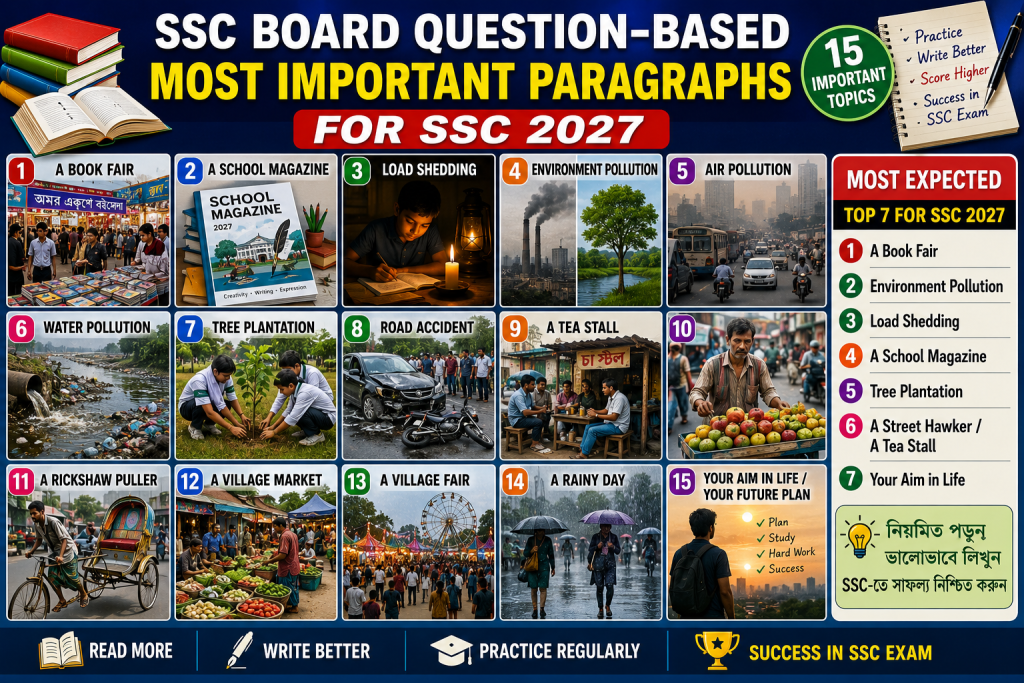
Most Expected for SSC 2026 (Top 10 Sure Common Topics)
✔ Importance of Learning English
✔ Environment Pollution
✔ Tree Plantation
✔ Preparation for SSC Exam
✔ Traffic Rules
✔ Mobile Addiction
✔ Physical Exercise
✔ Uses and Abuses of Social Media
✔ Spoken English Improvement
✔ Early Rising